

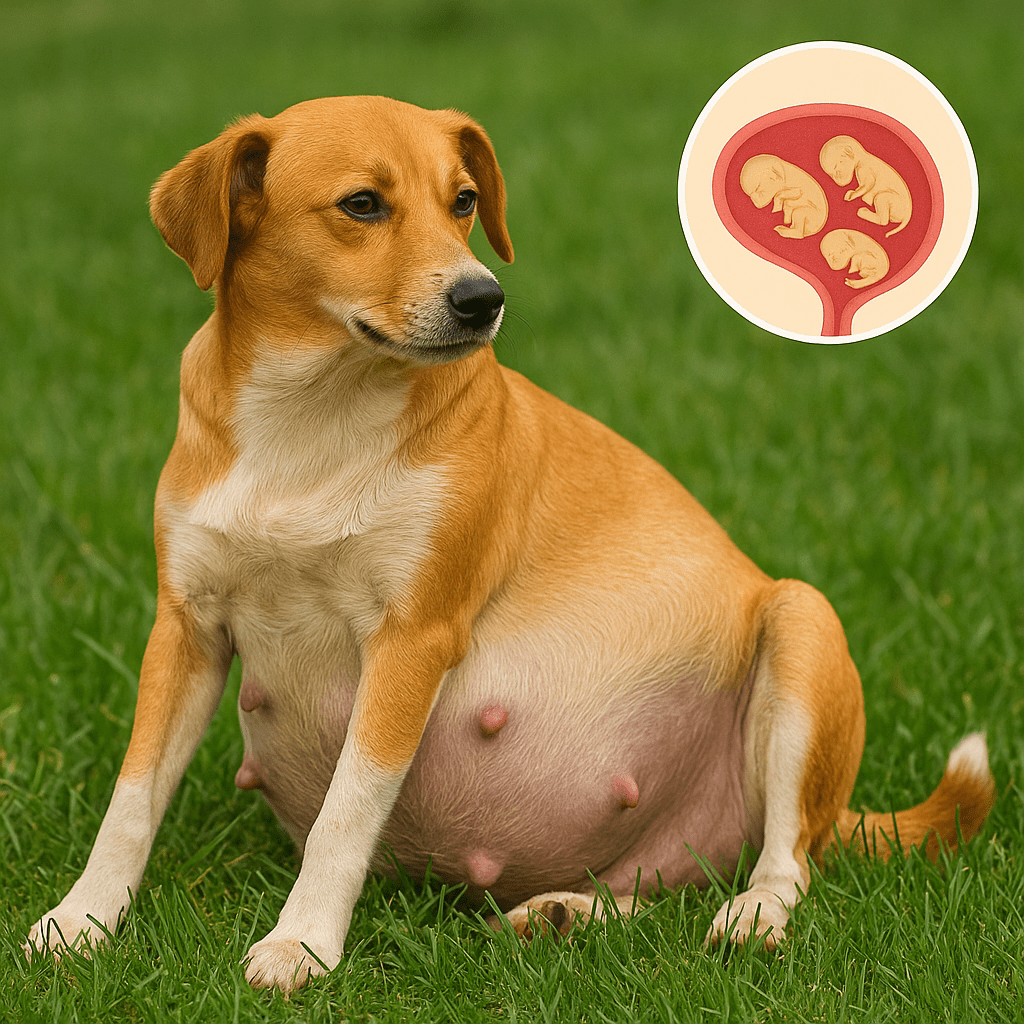
How Many Months Does a Dog Give Birth? (Gestation Period) and Pregnancy Symptoms
Is your dog pregnant? Find the definitive answer to the question "How many months does it take for a dog to give birth?" (average 63 days / 2 months) in this guide. Discover how to recognize the signs of pregnancy week by week, learn about caring for a pregnant dog, and understand why the risk of escape increases during the "nesting" period (the importance of a tag!).
Brief Answer: Dog Gestation Period
The average gestation period for dogs is approximately 63 days. When expressed in "months", this means about 2 months or 9 weeks. It is considered normal for this period to vary between 58 and 68 days, depending on the breed and the number of puppies.
The average gestation period for dogs is approximately 63 days. When expressed in "months", this means about 2 months or 9 weeks. It is considered normal for this period to vary between 58 and 68 days, depending on the breed and the number of puppies.
Do you suspect your dog is pregnant? Perhaps it was a planned mating, or maybe a little accident. Whatever the reason, the biggest question on your mind right now is probably: "How many months does it take for a dog to give birth?"
This is the beginning of an exciting, and slightly anxious, wait that crosses every dog owner's mind. The gestation period for dogs is much shorter than for humans, and this process requires accurate information and preparation.
This complete guide will not only give you a clear answer to the question "when will she give birth?" but will also provide a full roadmap on how to track the pregnancy week by week, the most critical safety measures during this period, and what to expect during labor.
Table of Contents
- How Many Months Does a Dog Give Birth In? (Clear Answer: In Days and Months)
- How Do I Know If My Dog Is Pregnant? (Definitive Diagnosis)
- Owner's Observations: Physical and Behavioral Signs
- Week-by-Week Dog Pregnancy Calendar (A 9-Week Journey)
- Pregnant Dog Care: 4 Critical Steps
- URGENT SAFETY WARNING: "Nesting" and ESCAPE RISK!
- Labor Begins! (3 Stages of Birth)
- EMERGENCY: When to Call the Vet? (Danger Signs)
- Unwanted Pregnancies and the Importance of Spaying/Neutering
- Conclusion: Being Prepared Makes the Process Beautiful
How Many Months Does a Dog Give Birth In? (Clear Answer: In Days and Months)
Let's start with the clear answer to this most frequently searched question by users:
Golden Information: Dog Gestation Period
The average gestation period for a dog is approximately 63 days.
If we were to answer this question in "months", dogs are pregnant for about 2 months (or 9 weeks). This period can vary between 58 and 68 days, depending on the mating day, breed, and number of puppies.
So, if you know when your dog mated, you can mark your calendar for 63 days later. However, most owners don't know that exact "moment" or can't be sure of the exact date. This is why knowing pregnancy signs and veterinary diagnostic methods is vital.
How Do I Know If My Dog Is Pregnant? (Definitive Diagnosis)
The most definitive way to determine if your dog is pregnant is through a veterinary examination. While your own observations can give you clues, these steps are essential for an accurate diagnosis and the health of the puppies:
- Hormone Tests (From 2-3 Weeks): Your vet can perform a blood test to detect the hormone relaxin. This is one way to confirm pregnancy early on.
- Palpation (Abdominal Examination) (Around 4 Weeks): An experienced vet can feel the small sacs (puppies) in the uterus around the 4th week with an abdominal examination (palpation).
- Ultrasound (From 4 Weeks): This is the most common and safest method. From day 25 onwards, puppies' heartbeats can be heard with ultrasound, confirming pregnancy.
- X-Ray (After 7 Weeks - From Day 45 Onwards): This is the clearest answer to the question "how many puppies are there?" The puppies' skeletons become visible on X-ray after day 45. Knowing the number of puppies is vital to know if a puppy "remains inside" during birth.
Owner's Observations: Physical and Behavioral Signs
Before a vet diagnosis, these signs will give you strong clues:
Physical Changes
- Enlargement and Color Change of Nipples: One of the earliest and most reliable physical signs. Nipples enlarge, become more erect, and turn a pinker/redder color.
- Weight Gain and Abdominal Swelling: Becomes noticeable, especially after the 4th week.
- Clear Vaginal Discharge: A slight, odorless, clear discharge is normal around the middle of pregnancy (around the 4th week). (If the discharge is bloody, foul-smelling, or green/yellow, go to the vet IMMEDIATELY).
- Milk Production: Mammary glands begin to fill with milk 1-2 weeks before birth.
Behavioral Changes
- Appetite Changes: Just like "morning sickness" in humans, some dogs may experience a brief loss of appetite or mild vomiting around the 3rd week of pregnancy. This usually gives way to a noticeable increase in appetite by the 4th week.
- Lethargy and Affection: She may sleep a bit more than usual. Some dogs become more withdrawn, while many exhibit excessive affection and clinginess towards their owner. This can be seen as a desire to be constantly by your side, similar to separation anxiety.
- "NESTING" Behavior (7-9 Weeks): This is a sign of impending labor. Your dog will search for a "safe" birthing area. She will start scratching at beds and blankets, and hiding in quiet, secluded corners (inside cupboards, under beds).
Week-by-Week Dog Pregnancy Calendar (A 9-Week Journey)
We can divide this 2-month (9-week) period into three main sections:
1st Month (Weeks 1-4): Fertilization and Implantation
- Week 1: Mating and fertilization occur. No signs yet.
- Week 2: Fertilized eggs (embryos) travel towards the uterus.
- Week 3: Embryos implant in the uterine wall. Some dogs may experience the famous "morning sickness" and loss of appetite this week.
- Week 4 (End of 1st Month): Nipples begin to pinken and enlarge. Your vet can now definitively see the pregnancy with an ultrasound and hear the puppies' heartbeats.
2nd Month (Weeks 5-8): Rapid Growth Phase
- Week 5: Puppies begin to grow rapidly (they are now fetuses). The mother's abdomen starts to become prominent. Her appetite skyrockets. This is the right time for a change in diet (switching to puppy food).
- Week 6: Puppies' organs, whiskers, and toes develop. The mother's abdomen becomes quite large.
- Week 7: The puppies' skeletal system begins to harden. Your vet can now perform an X-ray to clearly determine the number of puppies.
- Week 8: Puppies are almost fully developed. The mother begins "nesting" behavior. If you watch her abdomen carefully or place your hand on it, you can feel the puppies' movements!
3rd Month (Week 9): Preparation for Birth
- Week 9 (and Birth): Puppies are ready for birth. The mother's mammary glands fill with milk and begin to sag. Her body temperature drops (see: Signs of Labor). Restlessness and nesting behavior are at their peak. And the big moment arrives!
Pregnant Dog Care: 4 Critical Steps
- 1. Diet Change (Very Important): A pregnant dog's calorie and protein needs skyrocket. Your vet will recommend a gradual transition from her regular food to "High-Quality Puppy Food" starting from the 4th or 5th week of pregnancy. Puppy foods provide the high energy needed to nourish both the mother and the puppies.
- 2. Exercise (Lightened): In the first half of pregnancy, she can continue her normal walks. In the last few weeks (after the 6th week), avoid strenuous play, jumping, and wrestling with other dogs. Light, short, and calm walks help her digestion and keep her in shape.
- 3. Vaccinations and Parasites: It is ideal for her vaccinations to be up-to-date before pregnancy. Live vaccines are not given during pregnancy. ALWAYS consult your vet regarding internal and external parasite treatments; only products safe for pregnant dogs should be used.
- 4. Preparing a Whelping Box: Satisfy her "nesting" instinct at home. In a quiet, calm, warm, and less-used corner of the house, prepare a box/area with sides (so puppies can't get out but the mother can) lined with old towels or blankets. Feed her in this area to help her adopt it as her "safe den."
URGENT SAFETY WARNING: "Nesting" and ESCAPE RISK!
The "nesting" instinct in the final weeks of pregnancy is one of the highest periods of ESCAPE RISK.
Why? Because your dog's instincts tell her to find a "safer, quieter, more secluded" place. This can cause her to do something she would normally never do: escape from the house or yard. Her goal is to give birth in a "secret" place, like under a tree, in a basement, or a neighbor's yard.
A runaway pregnant dog is a double tragedy. She risks not only her own life but also the lives of her unborn puppies. She might give birth outdoors, under stress, and in a dangerous place.
At this moment, a clear ID tag and collar like Tagicons are life insurance for the mother and her puppies. It allows your neighbor, who finds her "nesting," to reach you in seconds by seeing your phone number on her collar. This is the difference between her safely returning home and giving birth to her puppies in safety.
Labor Begins! (3 Stages of Birth)
The clearest sign that labor has begun is a drop in body temperature (Normally 38.5°C, it drops below 37°C). Birth occurs in 3 stages:
- Stage 1: Preparation (Lasts 6-12 Hours): Uterine contractions begin. The dog is restless, trembles, pants, and scratches at her prepared nest. She refuses to eat.
- Stage 2: Arrival of Puppies (Lasts 3-12 Hours): Active straining begins. Puppies usually arrive at 30-60 minute intervals. The mother tears the sac of each puppy, cuts the umbilical cord, and licks it clean/helps it breathe.
- Stage 3: Expulsion of Placentas: After each puppy (or sometimes all together at the end), the placenta is expelled. There should be as many placentas as puppies. It is normal for the mother to eat them.
EMERGENCY: When to Call the Vet? (Danger Signs)
While dogs usually give birth without assistance, call your vet IMMEDIATELY in the following situations:
- If there is a green, black, foul-smelling, or bloody discharge (other than clear-pink) during pregnancy.
- If your dog has not given birth after 68 days.
- If restlessness in Stage 1 lasts longer than 24 hours.
- If the mother strains STRONGLY for more than 30-60 minutes without a puppy arriving (a puppy might be stuck!).
- If more than 2 hours pass between two puppies.
- If the mother is in severe pain or appears unconscious.
- If the mother is restless even after all puppies are born (a placenta or puppy might still be inside).
Unwanted Pregnancies and the Importance of Spaying/Neutering
If you don't want to go through this process or risk your dog's health (especially pregnancy during her first heat is very dangerous), the only and most permanent solution is spaying or neutering. Unwanted pregnancies are the number one reason for overcrowded shelters in Turkey.
For more detailed information on this topic, you can read our article Dog Spaying/Neutering Guide. Spaying/neutering also protects your dog from deadly diseases like uterine infection (Pyometra).
Once the puppies are born, a whole new adventure awaits you. These puppies will grow quickly and will soon need basic training, such as potty training.
Conclusion: Being Prepared Makes the Process Beautiful
Your dog's pregnancy is a short but intense journey of approximately 2 months. The two most important keys to enjoying this process rather than panicking are regular veterinary check-ups and taking precautions to ensure her safety (and thus her puppies'). Enjoy witnessing this miraculous journey!
Unique Gifts for Your Furry Friend


German Shepherd Dog Tag | Engravable Dog Tag
German Shepherd Dog Tag | Engravable Dog Tag
649 ₺
Sale price
649 ₺
Regular price
749 ₺


Chihuahua ID Tag (Male) - Engravable Tag, Custom Design
Chihuahua ID Tag (Male) - Engravable Tag, Custom Design
649 ₺
Sale price
649 ₺
Regular price


Male Yorkshire Terrier Dog Tag – Customizable with Name, Breed-Specific Design
Male Yorkshire Terrier Dog Tag – Customizable with Name, Breed-Specific Design
649 ₺
Sale price
649 ₺
Regular price
749 ₺


Female Yorkshire Terrier ID Tag – Engravable, Breed-Specific Design
Female Yorkshire Terrier ID Tag – Engravable, Breed-Specific Design
649 ₺
Sale price
649 ₺
Regular price
749 ₺
Sıkça Sorulan Sorular
Köpekler ilk ne zaman hamile kalabilir (kızgınlığa girer)?
Bu, ırka göre değişir. Küçük ırklar 6 aylıkken bile ilk kızgınlıklarına (heat cycle) girebilirken, büyük ırklarda bu süre 1.5 - 2 yaşı bulabilir. Bir köpeğin ilk kızgınlığında hamile kalması, tıpkı bir çocuğun hamile kalması gibi, sağlığı için çok risklidir.
Köpekler ortalama kaç yavru doğurur?
Bu da ırka ve annenin boyutuna bağlıdır. Küçük ırklar (Chihuahua, Terrier) genellikle 1-4 yavru doğururken, büyük ırklar (Golden, Alman Kurdu) 8-12, hatta daha fazla yavru doğurabilir. Kesin sayıyı bilmenin tek yolu, doğuma yakın çekilen bir röntgendir.
Köpeğimin doğumunun başladığını nasıl anlarım?
En net 3 belirti: 1) Vücut Isısının Düşmesi: Normalde 38.5°C olan vücut ısısı, doğumdan 12-24 saat önce 37°C'nin altına düşer. 2) İştahsızlık: Doğumdan 24 saat önce mama yemeyi tamamen kesebilir. 3) Yoğun "Yuva Yapma": Huzursuzca gezinme, titreme, nefes nefese kalma ve hazırladığınız doğum alanını veya dolap içlerini sürekli tırmalama.

0 comments