

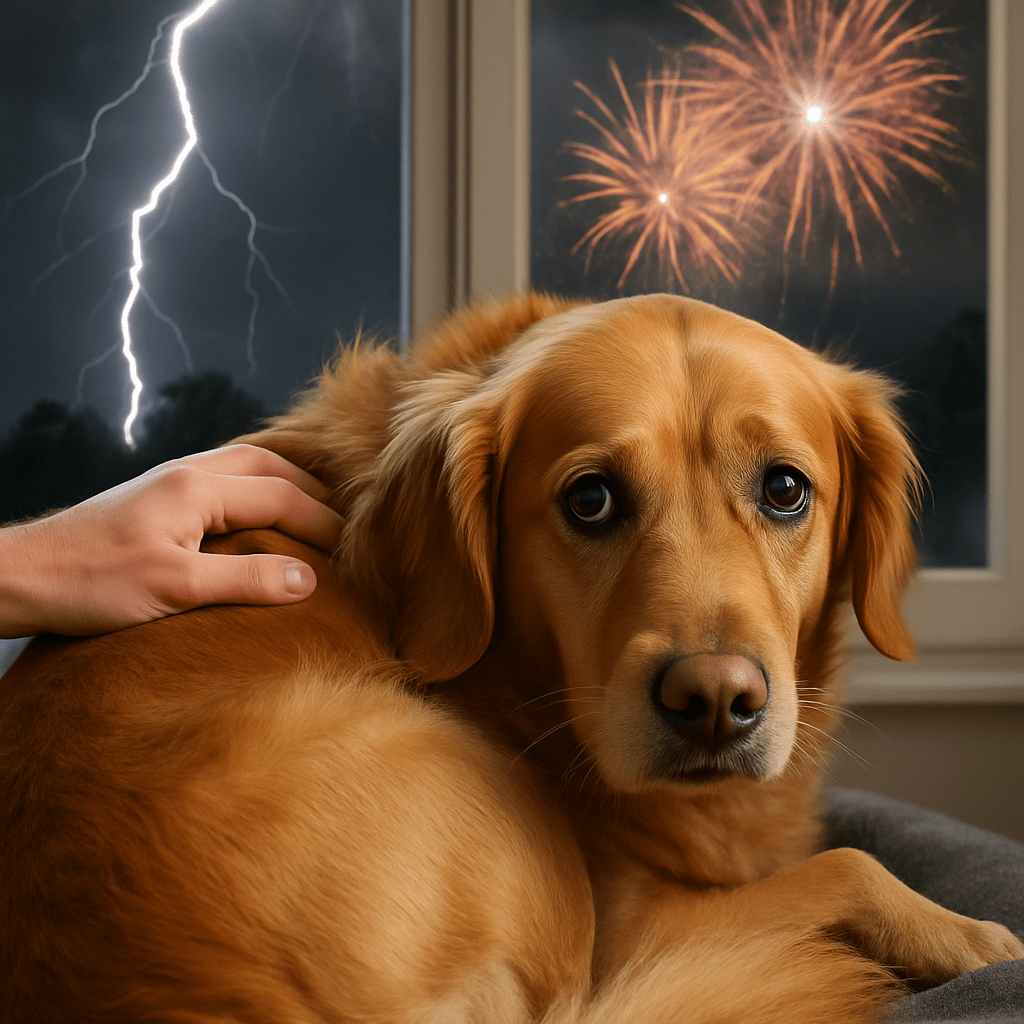
Fear of Thunder & Fireworks in Dogs: 7 Solutions
Are thunder or fireworks a nightmare for your dog? We have compiled the most effective calming methods for dogs that panic, tremble, and hide. More importantly, in this article, you can find out why dogs run away during these moments of panic and the number 1 safety precaution you should take against it (a tag!).
Quick Fix: 3 Rules in Case of Panic
- 1. Stay Calm: Your tension will transfer to them. Continue with your normal behavior.
- 2. Soundproofing: Close windows and doors, turn on TV/White Noise.
- 3. Safe Space: Encourage them to go to a pre-designated secluded area (Do not force).
The calmest moment of the day... and suddenly the sky thunders or a firework explodes in the distance. Does this sound, which is normal for you, cause your furry friend to plunge into a nightmare within seconds? Trembling legs, rapid breathing, attempts to hide under the bed, and an unending panic...
If this scenario sounds familiar, your dog may be experiencing Astraphobia (fear of thunder) or Phonophobia (fear of loud noises). This is not them being "spoiled," but a real and intense panic attack. Research shows that fear in dogs causes physiological responses similar to those in humans, and over time, this can turn into other anxiety disorders such as separation anxiety.
Even more importantly: Statistically, the highest number of lost dog cases occur during thunderstorms and firework celebrations. A panicked dog will jump fences they normally wouldn't, scratch at windows, and run off without knowing where they're going. This is a safety issue.
This comprehensive guide explains how to manage your dog when that moment of panic arrives and what scientific and practical measures you need to take to keep them safe.
Table of Contents: Roadmap to Managing Fear
- Why Does Astraphobia and Phonophobia Occur? (Scientific Foundations)
- When That Moment Comes: Emergency Calming Tactics
- Preparing a Safe 'Den' (Crate & Kennel Training)
- Pressure Therapy and Pheromones (Thundershirt, T-Shirt Method)
- Long-Term Solutions: Training to Overcome Fear
- URGENT SAFETY WARNING: Measures Against Escape
- Veterinary Support: Supplements and Medication
- Conclusion: Being Prepared Conquers Panic
Why Does Astraphobia and Phonophobia Occur? (Scientific Foundations)
Dogs' fears are not just about sound. Fear is often triggered by a combination of:
- Pressure Changes: Dogs can feel a drop in barometric pressure hours before a storm begins. This is why their panic starts 'prematurely'.
- Electrostatic Charge: Static electricity in the air during storms can bother long-haired dogs in particular and cause fear.
- Amplification (Sound Intensification): Dogs' hearing frequency range is much wider than humans', and they perceive sounds at a much higher intensity. A firework 10 kilometers away creates a disturbing bang in their ears.
- Trauma: Exposure to loud noises or accidental punishment during puppyhood can trigger fear.
What You Should Never Do During a Panic Attack (Don't Reinforce Fear!)
- NEVER Over-Comfort: Constantly petting or picking up a trembling dog, saying "Oh, my poor baby," sends them the message, "Yes, this situation is so bad that my owner panicked too and rewarded me." This reinforces the fear.
- NEVER Punish: Yelling at or scolding them if they bark, hide, or urinate out of fear will turn their fear into trauma.
- NEVER Take Them Outside: Taking them outside during a storm or explosion is an invitation for them to panic, break free from their leash, and run away. It's better for them to relieve themselves inside than to run away in panic.
When That Moment Comes: Emergency Calming Tactics
The moment a storm or explosion begins, your goal is to reduce your dog's stress level and gain control of the situation.
1. You Stay Calm (Be the Leader)
Dogs are very good at reading your body language and energy. If you get tense, run to the door, or become flustered, your dog will panic and perceive the situation as an "alarm." Continue with your normal activities. Read a book, cook. Clearly convey the message, "Everything is under control."
2. Block Sounds and Sights
Reduce the physical triggers of fear:
- Close Curtains/Blinds: Eliminate sudden flashes of light from lightning and fireworks (visual triggers).
- Create White Noise: To break through the sound of explosions and thunder outside, turn on a fan, air conditioner, calm classical music, *reggae* music, or the television (a calm channel).
3. Distract and Engage in Activity
If your dog is not in a state of panic, direct their brain away from fear by engaging them in "work." This activates a different part of their brain:
- Fill their favorite, long-lasting **Kong** toy with peanut butter or wet food. Licking behavior, similar to in cats, has a stress-reducing effect.
- Give them simple commands ("sit," "paw," "go to your place") and reward them with a **super tasty** treat when they perform correctly.
Preparing a Safe 'Den' (Crate & Kennel Training)
Dogs, by nature, seek enclosed, shelter-like places where they feel safe. Creating a special "panic den" for them at home helps them manage their fear.
- Location of the Den: This could be a **bathroom** with less sound, under the **stairs**, or their **crate** covered with a blanket. For dogs trained to use a crate, this area serves as a sanctuary.
- Preparation: Place their favorite bed, blanket, and a water bowl inside the den.
- Invite, Don't Force: The door should remain open. **Encourage** the dog to enter (by tossing treats or calmly sitting next to it), but never forcibly lock them inside. This should be their escape area.
Pressure Therapy and Pheromones
Advanced techniques can help calm a dog's nervous system.
- Pressure Therapy (Thundershirt): Just like a swaddled baby, gentle, continuous pressure applied to a dog's torso and chest has a calming effect. This acts as a form of acupressure that alleviates anxiety symptoms. If you don't have a special Thundershirt vest, a tightly wrapped T-shirt or elastic bandage can have the same effect.
- Synthetic Pheromones: Diffusers like Adaptil, sold at veterinary clinics, release synthetic versions of pheromones secreted by mother dogs to calm their puppies, creating a calming scent circle around the dog.
Long-Term Solutions: Training to Overcome Fear
Managing the moment of panic is important, but the ultimate goal is to fundamentally reduce this fear. This is a process that requires patience.
1. Desensitization Training
This is the process of associating the feared sound with something "harmless" or even "good." **Never done during a storm.**
- On a calm day, play "thunder sounds" or "firework sounds" from the internet.
- Play the sound at the lowest possible level. It should be a level where your dog does not react.
- While the sound is playing, play with your dog, give them a massage, or offer them very tasty treats. Help them associate the sound with something "positive" (play/food).
- As long as the dog remains calm, gradually increase the sound **millimeter by millimeter** over weeks. If they show signs of fear, immediately lower the volume and take a step back. Rushing will disrupt the process.
2. Counter-Conditioning
This is about changing a dog's negative emotional response to an adverse stimulus (thunder) to a positive one (calmness, happiness). Giving your dog a treat immediately when thunder starts will, over time, establish the perception that thunder = treat.
✅ URGENT SAFETY WARNING: Measures Against Escape
When all training and calming methods fail during a panic attack, one rule remains: **The dog must be guaranteed to return home.**
A dog with storm phobia may harm itself, break a window, or dig under a fence and escape in panic, fueled by adrenaline. These are the times when most lost pet cases occur. In such a situation, refer to our emergency guide for what to do after they go missing.
- TAG IS MANDATORY: A microchip requires the dog to be taken to a vet or shelter. However, the first thing your neighbor who finds them on a stormy night will do is call the **phone number** on their collar tag. A sturdy and legible tag, like Tagicons, is your dog's ticket home *in a crisis*.
- LOCK DOORS: For escape-prone dogs, it is necessary to lock doors or move the dog away from the closest entry/exit points during a panic attack.
Remember: Never remove their leash when a storm starts, and secure their tethering point.
Veterinary Support: Supplements and Medication
If the fear is so intense that your dog is harming themselves or your home, professional help is essential.
- Natural Supplements: Natural supplements containing ingredients like Lavender, Chamomile, or nutritional supplements with L-Tryptophan can gently soothe the nervous system. They should be given a few hours before a storm.
- Prescription Medications: Veterinarians may recommend short-acting sedatives or situational anxiety medications (Trazodone, Sileo) for **only high-risk panic moments** (like New Year's Eve fireworks). These medications should be given half an hour before the fear begins.
- Behaviorist: The most lasting solution is to seek support from a behavior therapist specializing in positive reinforcement to address the underlying cause of the fear.
Conclusion: Being Prepared Conquers Panic
You cannot control thunder or fireworks, but you can control your dog's reaction to these situations and, most importantly, their safety. Before the next storm arrives, prepare their "safe den," start desensitization training, and most importantly, ensure they have a tag that makes them reachable no matter what happens. Fear is not a weakness; it is a problem to be solved.
Unique Gifts for Your Furry Friend


German Shepherd Dog Tag | Engravable Dog Tag
German Shepherd Dog Tag | Engravable Dog Tag
649 ₺
Sale price
649 ₺
Regular price
749 ₺


Chihuahua ID Tag (Male) - Engravable Tag, Custom Design
Chihuahua ID Tag (Male) - Engravable Tag, Custom Design
649 ₺
Sale price
649 ₺
Regular price


Male Yorkshire Terrier Dog Tag – Customizable with Name, Breed-Specific Design
Male Yorkshire Terrier Dog Tag – Customizable with Name, Breed-Specific Design
649 ₺
Sale price
649 ₺
Regular price
749 ₺


Female Yorkshire Terrier ID Tag – Engravable, Breed-Specific Design
Female Yorkshire Terrier ID Tag – Engravable, Breed-Specific Design
649 ₺
Sale price
649 ₺
Regular price
749 ₺
Sıkça Sorulan Sorular
Köpeğim gök gürültüsünden korkuyor, neden?
Köpeklerde gök gürültüsü korkusuna (Astrofobi) neden olan şey sadece ses değildir. Köpekler, fırtına öncesinde barometrik basınçtaki düşüşü ve havada biriken elektrostatik yükü hissedebilirler. Ayrıca onların işitme frekansı çok daha geniş olduğu için sesi daha şiddetli algılarlar.
Fırtına anında köpeğimi teselli etmeli miyim?
Hayır. Aşırı okşama veya teselli etme, köpeğinize 'Korkulacak bir şey var ki, sahibi beni teselli ediyor' mesajını verir ve korkuyu pekiştirir. En iyisi, sakin kalmak, normal davranmaya devam etmek ve dikkatini dağıtmaktır (mama/oyuncak vererek).
Thundershirt (Basınç Yeleği) gerçekten işe yarıyor mu?
Evet, birçok köpek için işe yarar. Vücuda uygulanan sürekli, nazik bir basınç, tıpkı bir bebeği kundaklamak gibi, sinir sistemini sakinleştirir ve anksiyeteyi azaltmaya yardımcı olur. Panik başlamadan önce giydirilmelidir.
Köpeğimi yüksek sese alıştırmak için ne yapmalıyım?
Duyarsızlaştırma eğitimi (Desensitizasyon) uygulayın. Sakin bir günde, fırtına sesini çok düşük bir seviyede açın ve ses çalarken köpeğinizi ödüllendirin. Haftalar içinde sesi yavaşça artırarak, sesi pozitif bir şeyle ilişkilendirmesini sağlayın. Bu uzun vadeli bir çözümdür.
Yüksek sesten korkan köpek neden kaçar ve güvenlik önlemi ne olmalı?
Panikleyen köpekler, adrenalinin etkisiyle rasyonel düşünemez ve sığınak bulmak için çitleri aşar, kapıları zorlar. İstatistiksel olarak en çok kayıp vakası bu anlarda yaşanır. En önemli önlem, kayıp durumunda eve dönüşü garanti eden Tagicons gibi okunaklı ve dayanıklı bir künyedir.

0 comments